
Agentic AI in Retail: The New Operating System Powering Agentic Commerce
- By Amlan Sarkar, Practice Head, Software and Platforms
- 05 January, 2026
-
-


The retail industry is entering a new technological era defined by Agentic AI in Retail — goal-driven systems capable of reasoning, planning, and executing tasks with minimal human intervention. As retailers navigate complex consumer expectations, fragmented channels, and pressure for personalization, Agentic AI agents in retail are becoming the next strategic advantage. These systems are not just improving workflows—they’re fundamentally transforming how decisions are made across the retail value chain.
To explore the broader foundation of Agentic intelligence, you can refer to this in depth blog on Agentic AI.
What Is Agentic AI? How It Differs from Generative AI
Traditional automation follows predefined rules and workflows. Generative AI supports creativity and content generation. But Agentic AI for the retail industry goes further, combining autonomy, contextual understanding, multi step planning, and adaptive learning. Unlike traditional automation or RPA, Agentic AI represents a major leap: systems no longer wait for instructions—they pursue goals, evaluate data in real time, and act across systems.
This aligns with the Agentic AI Framework where intelligent agents perform sensing, reasoning, orchestration, and continuous learning across touchpoints. Retailers benefit from an Agentic AI Architecture that connects supply chain, marketing, pricing, and store operations into one cohesive decision engine. The figure 1 below illustrates the key difference between Generative AI and Agentic AI workflows.
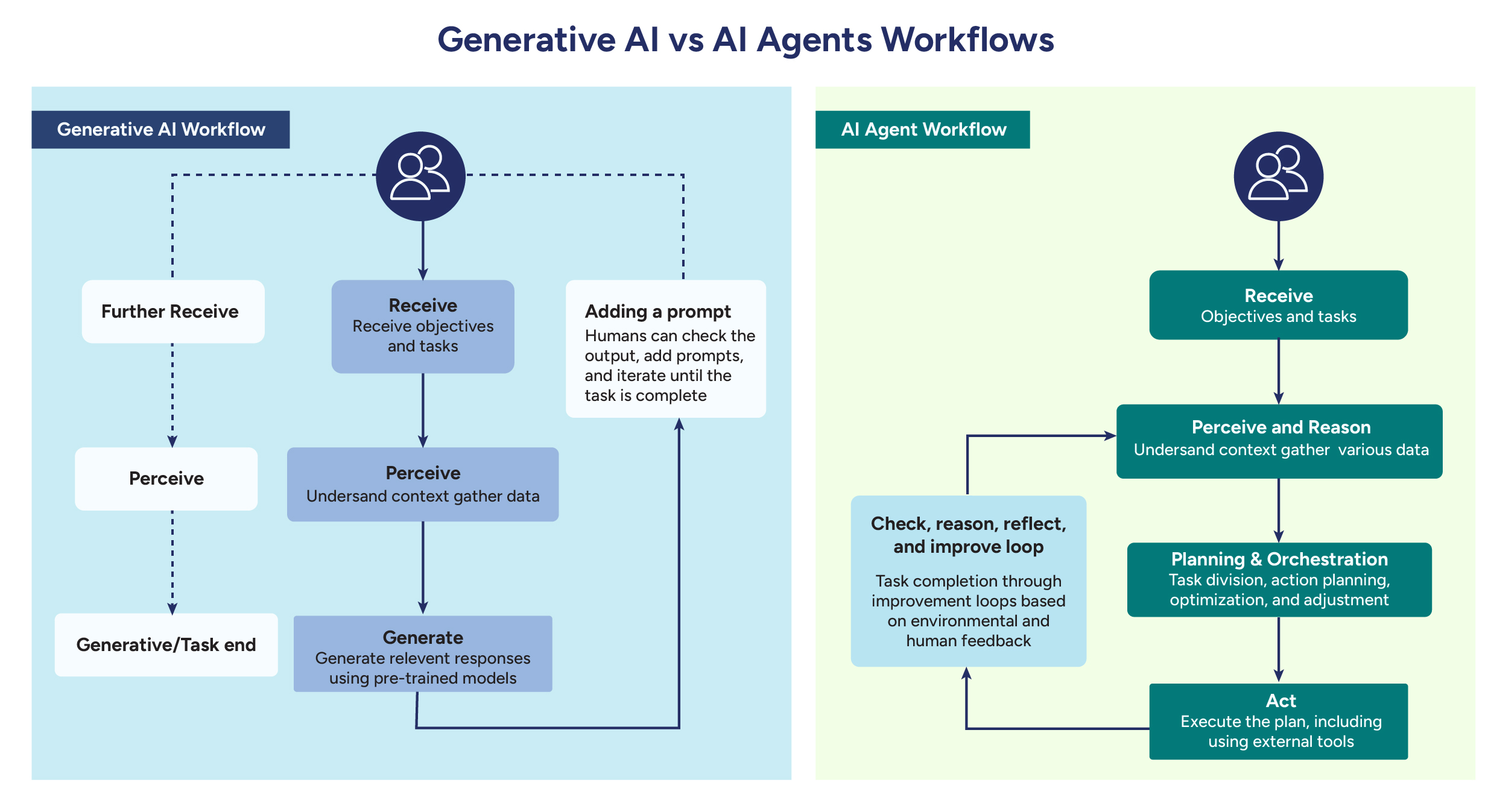 Figure 1: Source: weforum.org
Generative AI and Agentic AI in Retail: The Dynamic Duo
Retailers increasingly require intelligent systems that not only create content but also take action. Combining Generative AI and Agentic AI in retail enables “hyper autonomous, rapid marketing cycles” where GenAI generates creatives while agentic systems optimize offers, audiences, and timing across channels. This leads to faster execution, higher response rates, and better customer targeting—provided it is grounded in ethical, transparent AI governance.
This synergy is the backbone of modern AI platforms and tools for retail, enabling retailers to dynamically adapt pricing, optimize merchandising, personalize content, and orchestrate full-funnel campaigns without human micromanagement.
Agentic AI Market Size & Adoption in Retail
Retail is becoming the epicenter of Agentic AI adoption, driven by channel fragmentation and rising operational complexity. Recent analyses confirm that 2025 is the year Agentic AI moved from experimentation to execution:
- 76% of retailers plan to increase their AI agent investments.
- Retailers worldwide are piloting or scaling autonomous systems across operations, pricing, and merchandising.
- Agentic AI can unlock a global SI services pool approaching $0.9–1.1 trillion, with strong contributions from retail/CPG.
These signals prove that Agentic AI market size is accelerating sharply as retailers move past GenAI pilots and into enterprise Agentic AI. Figure 2 shows the global SI services value pool for Agentic AI by region and verticals highlighting retail/CPG as a key growth segment.
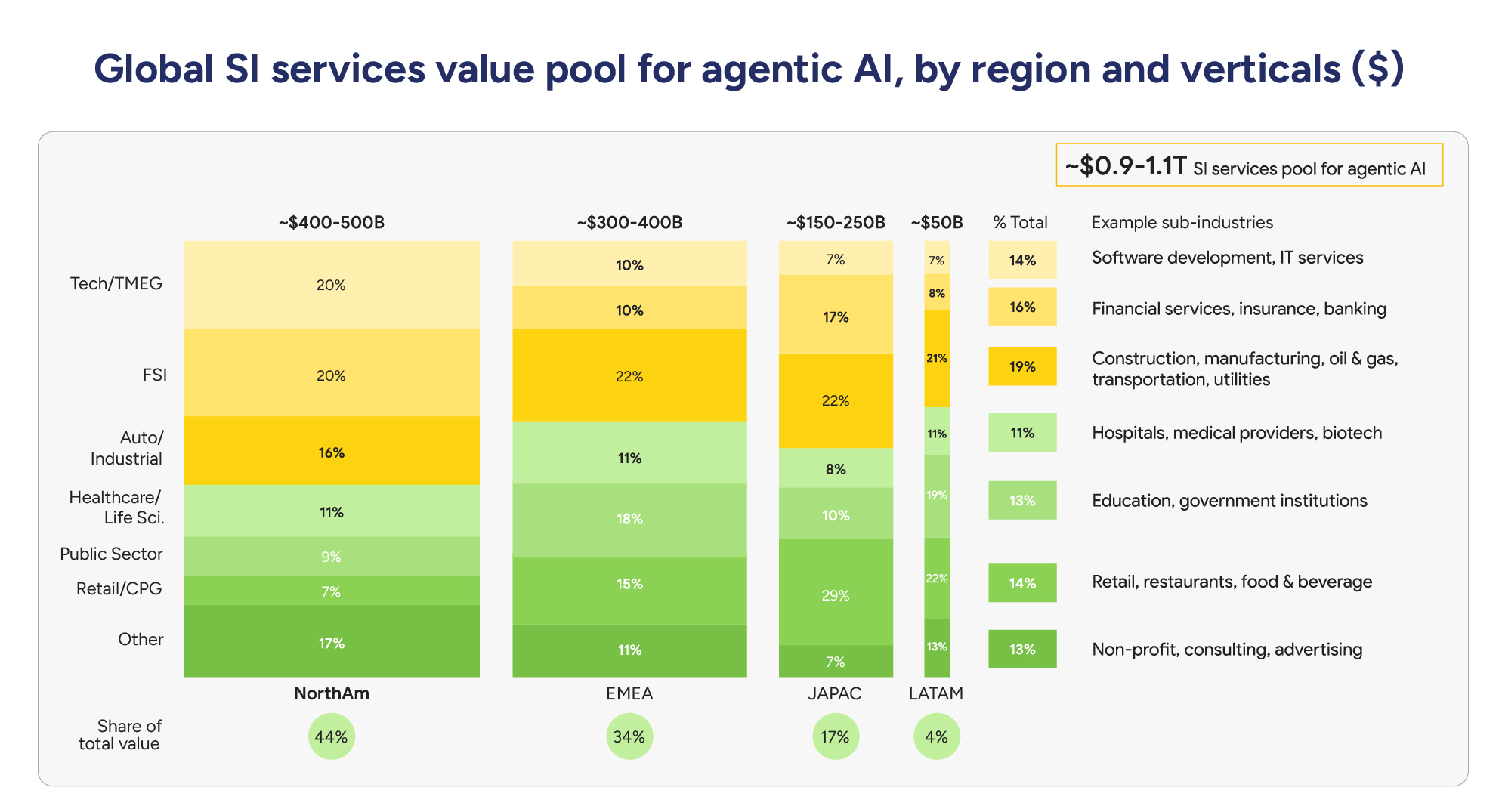 Figure 2: Source: Google Cloud TAM analysis
 Figure 3: Source: Google Cloud TAM analysis
Industry Pain Points Driving Agent Adoption
Retail and other sectors face systemic challenges such as slow personalization, fragmented processes, and rising operational complexity. Figure 4 illustrates these pain points across industries.
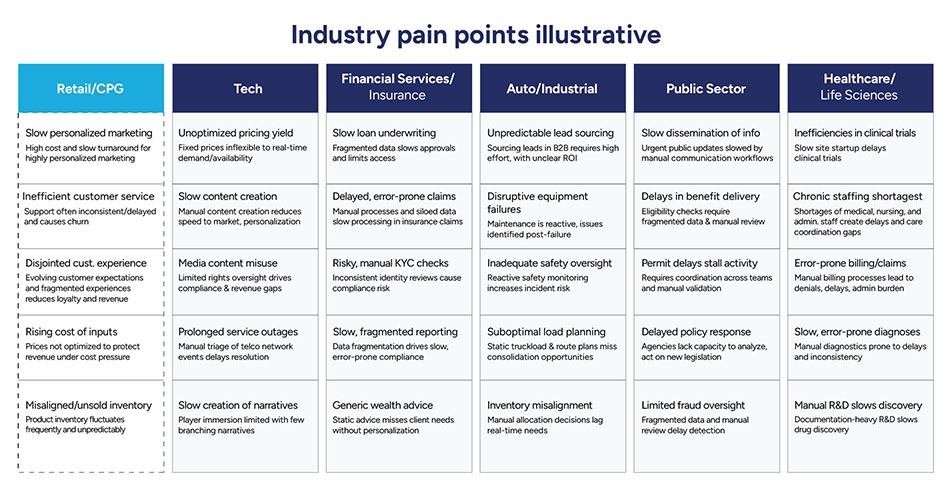 Figure 4: Source: Google Cloud TAM analysis
What this means for retailers:
Pain points are systemic and data intensive, requiring continuous decisions—not batch processes. Agentic AI directly tackles these by automating decisions and actions across customer, commerce, and supply processes.
How Agentic AI Is Transforming Retail (Real World Use Cases)
Agentic systems reshape the entire retail lifecycle. Here are some Agentic AI use cases in retail:
1. Guided Shopping & Retail AI Agents: Conversational shopping assistants summarize reviews, recommend products, and complete in chat transactions. retail AI agents now operate across web, apps, and messaging. This elevates personalization while reducing customer effort.
2. Dynamic Pricing & Promotion Optimization: AI agents analyze competitor moves, elasticity, inventory, and real time behavior to autonomously adjust prices and offers. This is one of the most valuable benefits of Agentic AI in retail operations, improving margins and conversion.
3. Supply Chain & Inventory Rebalancing Agents: Agents predict demand fluctuations, identify risks, reallocate inventory across regions, and trigger replenishment automatically. This reduces out of stocks and improves availability.
4. Campaign Execution & Marketing Automation: GenAI creates messaging while Agentic AI tests variants, reallocates budget, and intensifies winners—closing the loop between creative and action. This is a standout real world Agentic AI use case in retail marketing.
5. Service & Returns Automation: 24/7 service agents track shipments, process returns, manage refunds, and escalate exceptions—significantly lowering support costs.
These represent the foundation of the future of retail with Agentic AI, where operations become self optimizing.
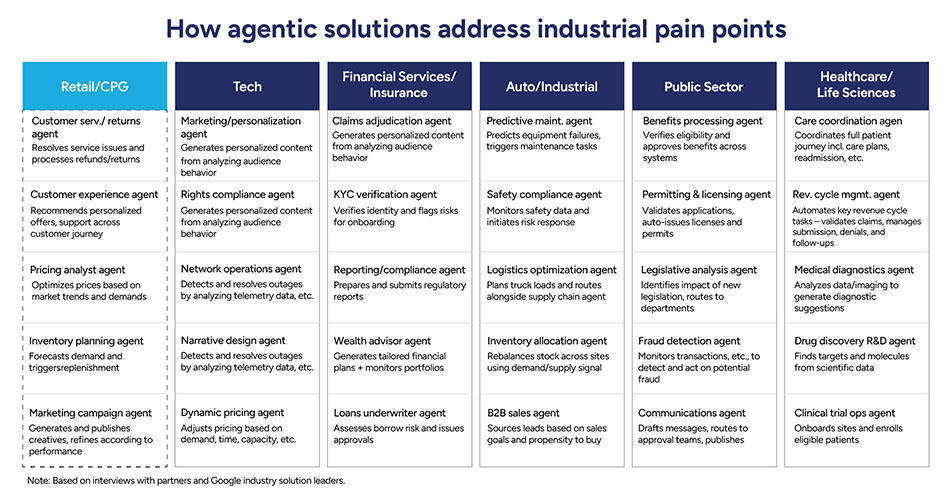 Figure 5: Source: infosys.com
Why Enterprises Are Deploying Agentic AI based agents in Retail
Enterprise retailers are moving towards Agentic AI because it delivers:
• Continuous decision-making instead of batch processes
• Reduced operational friction across supply chain and pricing
• Real-time merchandising adaptability
• Higher customer engagement through predictive interactions
• Cross-channel orchestration that cannot be achieved manually
Agentic agents enable retail operations to work across OMS, ERP, POS, CRM, and logistics systems—coordinating tasks faster than human-run workflows.
Agentic AI Strategy: How Retailers Can Prepare
Retailers looking to scale the impact of Agentic AI need a disciplined, enterprise aligned roadmap. A strong strategy typically includes the following pillars:
1. Set clear objectives and guardrails : Identify the highest value domains such as pricing, replenishment, marketing, customer assistance, or guided shopping and define the level of autonomy each agent should have. Clear intent and boundaries ensure AI systems act responsibly and strategically.
2. Establish a unified enterprise data backbone: Agentic systems depend on real time visibility into inventory, product attributes, customer behavior, supplier data, and traffic patterns. Clean APIs, well structured data pipelines, and a unified data layer are foundational to enabling intelligent decision making at scale.
3. Combine GenAI creativity with Agentic AI execution: GenAI can generate content, insights, and recommendations—while Agentic AI acts, orchestrates workflows, and optimizes outcomes. The real power emerges when both work together in a closed loop.
4. Begin with two proven, high ROI use cases: Most retailers see the fastest impact from:
• Dynamic pricing agentsthat optimize margins and sell through automatically.
• Customer service or returns agents that reduce operational load while improving satisfaction.
5. Prepare for agent driven digital marketplaces
: As product discovery increasingly shifts into AI interfaces like ChatGPT, Gemini, Copilot, and other agent platforms, retailers must ensure their product, pricing, and brand data is structured for AI first discoverability.
This is quickly becoming the next major competitive battleground.
Conclusion: Agentic AI for Retail Decision Making
Agentic AI isn’t simply the next step in automation—it represents a profound shift in how retailers operate, innovate, and respond to market dynamics.
Realizing its full potential demands a rethinking of retail operations from the ground up. Processes must be redesigned with agility and flexibility at their core, creating the conditions for AI agents to integrate smoothly and elevate performance across pricing, supply chain, merchandising, marketing, and customer experience.
This transformation begins with a strong data foundation, data that is clean, connected, and accessible. Once this backbone is in place, retailers can deploy modular, easy to integrate AI agents that deliver rapid, measurable wins while paving the way for scalable, enterprise-wide innovation.
We help retailers accelerate this journey by designing and deploying enterprise grade Agentic AI solutions that deliver tangible impact across the value chain. With deep AI engineering capabilities and strong retail domain expertise, we support brands in moving confidently from pilot ideas to fully operational, autonomous retail systems.
Those who act now will be best positioned to lead in a future defined not by managed processes, but by intelligently orchestrated, self optimizing retail operations.
References:
2. https://services.google.com/fh/files/misc/agentic-ai-tam-analysis.pdf
3. https://www.infosys.com/iki/images/tech-navigator-agentic-enterprise-ai-playbook.pdf